
Atomic Gridlock: How Morphing Roadblocks and Sessile Anchors Govern the Life of Fusion-Grade Tungsten
The Fusion Challenge: Materials at the Heart of a Star
Tungsten has long been the frontrunner for the plasma-facing components of future fusion reactors. With its peerless melting point and exceptional thermal conductivity, it is uniquely qualified to serve as the structural containment for a man-made star. However, the environment inside a tokamak is a crucible of destruction.
During service, tungsten is subjected to relentless high-energy neutron bombardment. This process triggers a cascade of "atomic billiards," a microscopic scarring where neutrons strike the lattice, displacing atoms and creating a dense population of vacancy loops and defects. If we are to harness fusion energy, we need materials that can survive this extreme environment without becoming dangerously brittle or losing structural integrity.
The Mystery of the Evolving Roadblock
As these defects accumulate, tungsten undergoes "irradiation hardening." To visualize this, imagine that dislocations—the primary agents of metal deformation—are like cars moving along a highway. The defects created by radiation are roadblocks. When dislocations are pinned by these roadblocks, the metal hardens, but often at the cost of its ductility.
The central mystery has been the nature of these obstacles. Previously, engineering models often viewed these roadblocks as static, unchanging structures. Our latest research at the Crystal Mechanics Lab asks a more dynamic question: How do these vacancy loops morph when struck by a dislocation? Does the roadblock break, get pushed aside, or transform into an even more stubborn anchor?
Molecular Dynamics: The Atomic-Scale Time Machine
To observe these interactions, we utilize Molecular Dynamics (MD), a digital microscope capable of watching millions of atoms "dance" in real-time. We specifically focus on edge dislocations. While screw dislocations often dominate deformation in BCC metals, edge dislocations are the "canaries in the coal mine" for irradiation damage; they are naturally highly mobile, making their drastic reduction in speed when hitting a roadblock a sensitive indicator of material health.
Our simulations are massive, involving 3.6 million atoms and a dislocation density of 5×10¹⁴ m−2, reflecting the actual damage levels found in self-implanted tungsten. We examine "Vacancy Loops"—clusters of missing atoms that form either flat platelets (open loops) or circular prismatic structures (closed loops).
A Tale of Two Orientations: Parallel vs. Inclined
The research reveals that a roadblock’s strength is not just about its size, but its crystallographic orientation relative to the approaching dislocation.
Parallel Loops (The "Weak" Roadblocks)
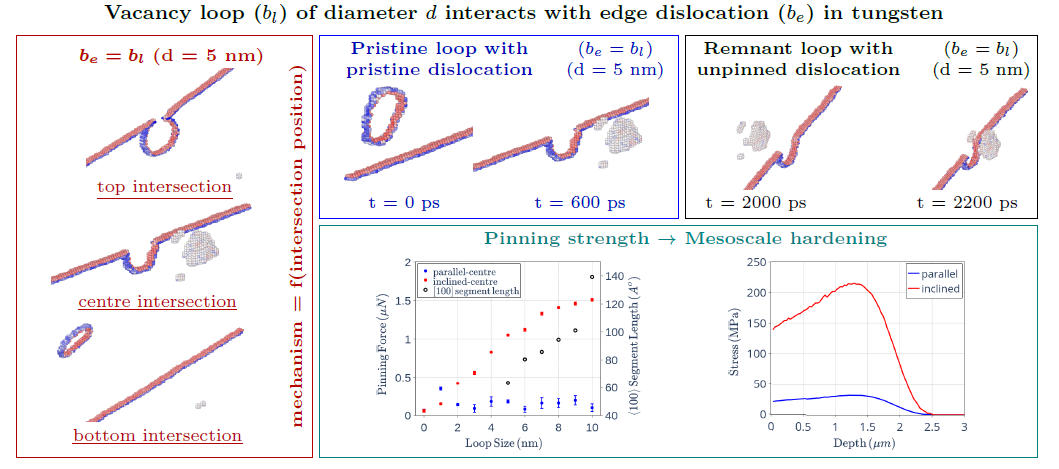
Parallel loops share the same Burgers vector as the dislocation (be=bl=21⟨111⟩). These follow "Interaction I," where the dislocation bows and breaks away. However, their fate depends entirely on the geometry of the "hit":
Top Interactions (Absorption): The loop is absorbed into the dislocation, forming a "superjog." Think of a superjog as a permanent stair-step kink in the dislocation line that adds internal friction as it is dragged along.
Bottom Interactions (Repulsion): The loop is never actually touched; instead, the long-range elastic fields push the loop ahead of the dislocation.
Defect Clearing: Both pathways lead to "clearing," where the roadblock is removed or moved, leaving the path easier for the next "car" to pass.
Inclined Loops (The "Stubborn" Roadblocks)
When the loop is inclined (at an angle of 70.53∘), it triggers "Interaction II," a far more formidable atomic reaction:21⟨111⟩−21⟨111ˉ⟩→⟨010⟩This reaction creates a ⟨010⟩ segment that is "sessile," or completely immobile. It acts as a permanent anchor. To unpin, the dislocation segments must bow out into a screw dipole, eventually using cross-slip to move around the anchor and annihilate the dipole.
Repeated Impact: The Persistence of Strength
Understanding a single impact is only half the story. To predict material life, we must look at the cumulative damage of a second pass (Interaction D). Our findings show a stark contrast in how parallel and inclined roadblocks recover.
While parallel loops transform into "remnant defects" that are significantly weaker, inclined loops are practically immortal; they maintain their structure and pinning force pass after pass.
Why This Matters: From Atoms to Engineering
The leap from atomistic simulations to structural engineering is the bridge we are building. Traditionally, Crystal Plasticity Finite Element (CPFE) models relied on "calibrated" or phenomenological parameters—essentially educated guesses based on macroscopic observations.
Our work provides a physically-based foundation for these models. By replacing "guesses" with "measurements of atomistic reality," we ensure that engineering models remain predictive even when extrapolated beyond the conditions they were calibrated for. If we understand the behavior of the "microscopic bolt" (the vacancy loop), we can finally predict the long-term stability of the entire "bridge" (the fusion reactor wall).
Looking Ahead: Designing the Future of Fusion
The mission of the Crystal Mechanics Lab is to move beyond mere observation and into the realm of active material design. By quantifying these "atomic dances," we are creating the blueprint for the next generation of fusion-ready alloys.
Our next frontiers include investigating how these interactions change at high service temperatures and how mixed populations of dislocations—the real-world "traffic jam"—behave under stress.
Join the Mission: The materials challenge is the final hurdle for clean fusion energy. We invite researchers and students to explore our latest publications and join us in solving the most difficult problems in computational materials science. Together, we can build the star.